The object in context
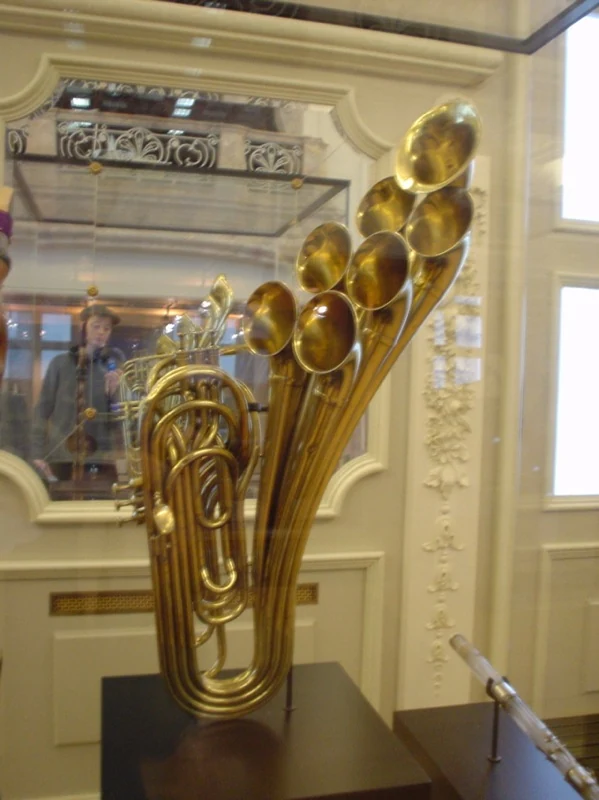
Adolphe Sax’s instrument has six independent piston valves and seven bells. The Musical Instruments Museum explains that the seventh bell sounds when no valve is used: the arrangement corresponds to seven trombone slide positions. Developed from 1852 and perfected in 1867, the system offered a striking mechanical solution but proved too complicated to become standard.
Try this when you look
Count the bells, then trace a valve’s connection rather than assuming that all bells sound together. Make a distinction between sound production, the route through a tube and the player’s action. A photograph can show the plumbing, but it cannot prove the instrument’s tone or ease of playing.
Before you visit
The museum identifies a late nineteenth-century brass instrument, 84 centimetres high, inventory 1288. Use that number when enquiring about current display. Our licensed photograph is a collection reference image; it is not a recording or a test of the instrument.

- The object in context: Adolphe Sax’s instrument has six independent piston valves and seven bells.
- Try this when you look: Count the bells, then trace a valve’s connection rather than assuming that all bells sound together.
- Before you visit: The museum identifies a late nineteenth-century brass instrument, 84 centimetres high, inventory 1288.