
01 · Start with the whole
Stand at a permitted viewing distance and describe the main arrangement before hunting for details. Is the work tall, wide, dense or sparse? Find the strongest contrast. Write a sentence using only observable features.
02 · Choose a detail
Follow one line, material change or repeated shape. Record three observations without guessing an intention. A useful note might be “the bright patch appears beside the darkest figure”, rather than “the artist wants us to feel hope”.
03 · Read and compare
Now consult the label or collection record. Mark information you could not have discovered by looking alone: a date, an attribution, a restoration or a former use. Return to your first sentence and change it only where the evidence warrants.
04 · Leave with a question
Save a question rather than a verdict. Compare a second object using the same observation, not a league table of beauty. Our object notes offer different tasks for a painting, a house, a fossil and an instrument.
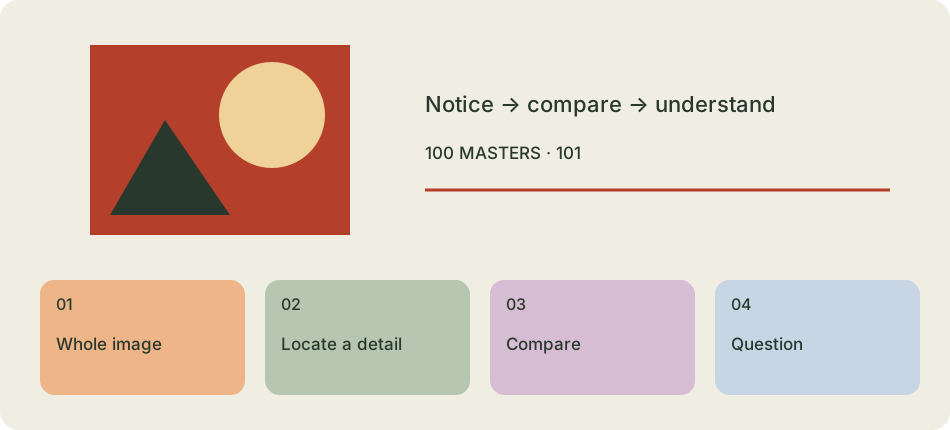
- Whole image — Describe the strongest visible contrast.
- Locate a detail — Follow a colour, gesture or line.
- Compare — Test your observation on a second work.
- Question — Ask what evidence could change your reading.
Keep exploring
Read the label before comparing the objects
A museum label is a compressed record, not a verdict on everything you see. Separate what it names from what you infer. The maker, attribution, date, material, inventory number and collection can each answer a different question. A photograph in a collection record does not prove that the object is currently on display.
Make six separate observations
- Copy the maker line, including “attributed to”, “workshop of” or another qualification.
- Copy the date with its uncertainty. “About 1700” is not an exact year.
- List the material or technique; do not infer it solely from a photograph.
- Keep the inventory number separate from the title and from a campaign's book number.
- Record the collection that holds the object, not an assumed exhibition venue.
- Leave current display and image reuse rights unknown until their own notices confirm them.
Compare two deliberately fictional records
Training record A reads: “Attributed to Maker A; about 1700; oil on canvas; inventory TRAIN-A; Example Collection.” Training record B reads: “Maker B; 1720; engraving on paper; inventory TRAIN-B; Example Collection.” Neither is an actual museum object or a reconstruction of a missing catalogue card. The diagram represents record fields, not an invented artwork.
You can say the records name different techniques and different date statements. You cannot say A is definitely by Maker A, that both objects are displayed together, or that either image is free to reuse. Before comparing their appearance, write one observation and one unresolved question for each. For A, an unresolved question is the basis of the attribution. For B, it might be whether the date refers to making this impression or another part of the record.
Return to the source
Look up the exact collection record and compare its inventory number with your note. Preserve qualifiers when quoting or paraphrasing. If a wall label and online record differ, record both versions and ask the museum; do not silently select the more confident wording.
The Royal Museums of Fine Arts of Belgium collection resource is a starting point for real records. The 100 Masters campaign belongs to 2016. Neither that campaign nor this reading exercise confirms today's display, opening hours, admission or permissions. The downloadable worksheet keeps those decisions separate so an old campaign address does not become a current visiting promise.
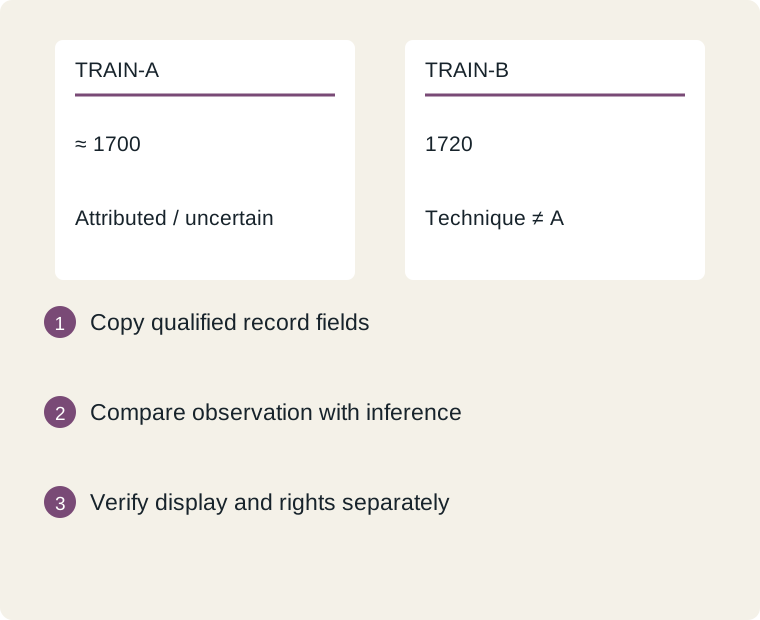
Text equivalent: Copy qualified record fields → Compare observation with inference → Verify display and rights separately
| Field | Completed example |
|---|---|
| Maker and qualifier | Attributed to Maker A (fictional) |
| Date as stated | About 1700, not an exact year |
| Material / technique | Oil on canvas, training example |
| Inventory and collection | TRAIN-A, Example Collection |
| Observation / unresolved question | Attribution basis remains unknown |
| Current display / image rights | Both unknown; ask the actual museum |
Blank worksheet and worked example ↓
Primary context: Royal Museums of Fine Arts of Belgium: collection