
The book entry and the museum records
The 2016 contents name no.13 as Hacker Storks, circa 1900, by Christian Hacker, on printed page 36. The Toy Museum’s archived records separately identify inventories 234 and 375, both attributed to Christian Hacker and located geographically in Nuremberg, Bavaria, Germany. Record 375 explicitly refers readers to inventory 234. The book number and museum numbers belong to different systems; the complete page 36 is still needed to establish which objects and photographic arrangement appeared in that edition.
Inventory 234: a stork with linked miniature objects
The museum calls inventory 234 Cigogne. Its description says the stork-shaped doll opens to reveal small objects attached to one another by a string. The inventory reports a height of 13.5 cm. No manufacture date is supplied in the captured description. The photograph shows the body separated from the head and a line of miniature objects beneath it. Retain the museum attribution and number when using the image; do not label a similar dealer photograph as this inventory.
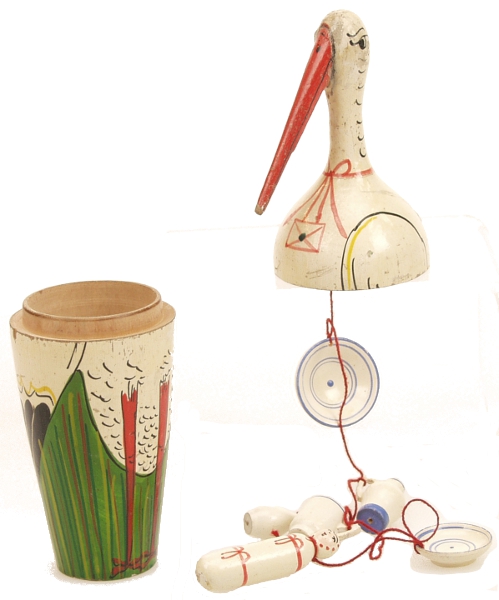
Inventory 375: a stork that opens
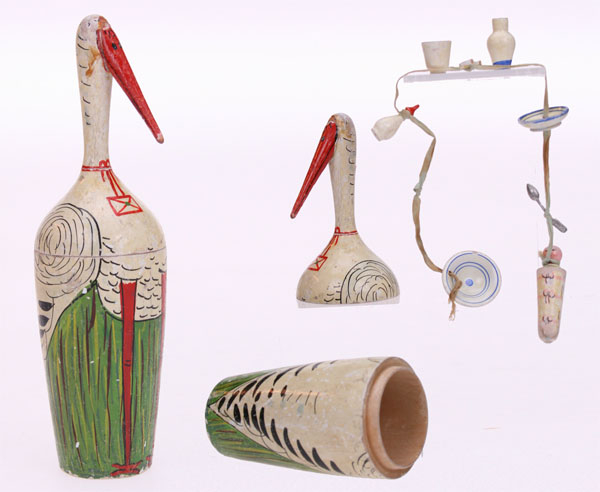
The museum calls inventory 375 Cigogne poupée gigogne. Its proposed dating is 1910–1920?, with the question mark retained; this is different from the approximate date in the 2016 contents. Its reported height is 17.5 cm. The description lists a baby, spoon, plate, cup, feeding bottle, vase and bowl inside. The archived condition note says the beak had been glued back, the vase had come away from the fabric strip, and the connecting cord was detached from the head. These are historical observations, not a report of the object’s condition today. The record cites Swantje Köhler’s Christian Hacker and a reproduction of a manufacturer’s catalogue page; that citation does not mean the cited publication has been obtained here.
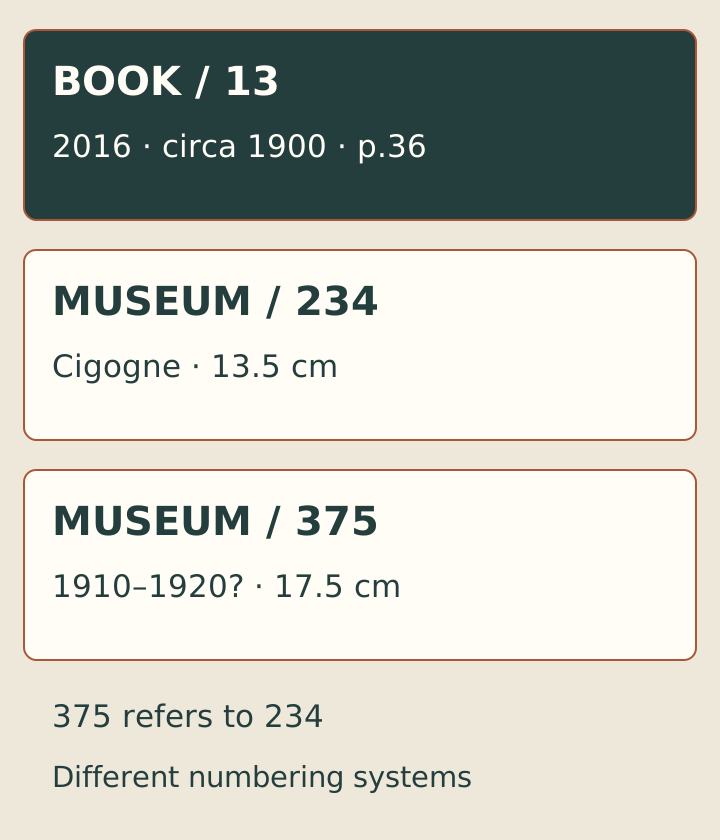
Book no.13: circa 1900, printed p.36. Museum inventory 234: Cigogne. Museum inventory 375: Cigogne poupée gigogne, dated 1910–1920? and explicitly referring to 234. The exact book photograph remains unverified.
Read the photographs in three passes
First identify the record: read its inventory label before comparing the bird shape. Next describe what is visible: the division of the body, the location of the head, the string or strip, and the miniature contents. Finally compare those observations with the museum’s text. In the image for 375, a closed form appears beside separated components and accessories; the composition alone is not evidence of how many distinct toys are represented. Neither a still photograph nor the catalogue description is permission to open, pull or operate an old museum object.
A completed identification note
Object reference: Toy Museum inventory 234. Attribution: Christian Hacker, as recorded by the museum. Visible evidence: separated stork-shaped body and head; miniature objects connected by a string. Source: museum record captured on 1 December 2014, with the photograph credited to the Toy Museum of Brussels. Unresolved: the exact relationship between this photograph and printed page 36 of the 2016 book. For inventory 375, make a separate note with the museum’s uncertain date and its cross-reference to 234; do not merge both into a single invented inventory number.
Before a visit or a comparison
The archive dates identify when the web records were preserved, not when the photographs were taken or the toys made. The records do not establish current display or visitor access. Use the collection and museum information as starting points, then confirm current arrangements with the institution.
Find the printed entry
KBR’s Bibliographie de Belgique, February 2017, records the three 2016 editions below. Search a library catalogue by the complete ISBN, select the matching language, then ask for printed page 36 and its accompanying image and credit. The public contents place the storks at no.13; PDF viewer page 36 in an extract need not be printed page 36 of the book.
- EN — 100 treasures from the Brussels’ museums; ISBN 978-2-39025-001-2; KBR BB A 2017 436.
- FR — 100 trésors des musées bruxellois; ISBN 978-2-87386-999-1; KBR BB A 2017 437.
- NL — 100 schatten uit de Brusselse musea; ISBN 978-2-39025-000-5; KBR BB A 2017 431.
The March 2018 Anet acquisitions list also records the Dutch edition at EHC: 830489 [C5–076 ec]. This is a dated library holding reference, not the toy’s museum inventory number or a promise of present availability. KBR’s BB references identify the publications. Neither bibliography reproduces the storks’ object page.
The museum records and original photographs below are identified by inventories 234 and 375. The full printed page 36 is still needed to verify the book’s exact selection and photographic arrangement.
Primary sources and scope
The original museum photographs and inventory descriptions 234/375 are available. The complete printed page 36 and its exact photographic arrangement remain unverified. The dating of record 375 retains the museum’s question mark.